The Commons Has a Balance Sheet
The pattern of productivity compounding upward into asset values while wages stagnated, the predistributive architecture dismantled, the redistributive tools strained past their design limits is one instance of a longer pattern. What happened to wages between 1975 and 2020 is what has happened, repeatedly, whenever capital has identified a productive commons it could enclose, privatize, and extract without compensating the people whose labor and contribution made the commons productive in the first place.
The English enclosures of the sixteenth through nineteenth centuries were the first industrial-scale run of this pattern: common land on which generations of farmers had worked, grazed, and gathered was converted, through acts of Parliament and private power, into private property. The displaced peasants became wage laborers. The landed gentry became the owners of what had been held in common. The commons was productive and it was unowned. Capital identified the productivity, privatized the asset, and captured the return. The people whose labor made the commons productive received wages if they were lucky and nothing when the relationship ended.
That logic has run through every chapter of the American economy this Declaration has traced. The plantation economy ran it on human beings. The industrial economy ran it on labor.11 The platform economy runs it on something larger and more fundamental: the entire substrate of collective human production, the commons of care, knowledge, relationship, culture, and civic life on which every formal economic transaction ultimately depends. What is happening now with artificial intelligence is not a new chapter in that story. It is the same story, running at civilizational scale and software speed, with a new target: not a specific asset class, but the conditions of production themselves.
The Tool Is Inevitable. The Ownership Is Not.
Artificial intelligence substitutes for cognitive labor. Robotics substitutes for physical labor. Together, they are the productive infrastructure of the twenty-first century, and their deployment is not optional. The demographic arithmetic of every advanced economy requires them. Populations are aging, from Japan and China to Spain and Italy to the United States. Birthrates are below replacement across every industrialized society, because the expense of raising and educating children into their mid-twenties has moved reproduction from a net asset to a liability.12 Raising a family in the twenty-first century is not going to get cheaper. As the Baby Boomers fully retire, the workforce that built the twentieth century is contracting, and the care economy, the manufacturing economy, the service economy, and the knowledge economy cannot be sustained at their current scale without the productive augmentation these tools provide. Resistance may be a personal choice, but it is not an available position for businesses or national economies. The tools are being built, and they will be integrated across every sector of the economy in our lifetimes. The only remaining question is who owns what they produce.
The argument this Declaration makes is not against the technology. It is against the default ownership architecture under which the technology is being built.
It is against the default ownership architecture
under which the technology is being built.
The distinction is not rhetorical. The same tools deployed under two different ownership structures produce two different societies. Under the first, AI models and robotic infrastructure are owned by a small number of private entities that captured the commons before governance frameworks existed to protect it; the returns from every productivity gain the tools generate flow to the asset holders; the workers displaced by automation receive nothing from the value their replacement creates; the communities whose knowledge trained the models hold no stake in the infrastructure their contribution made possible. Under the second, the same tools are built on a commons whose ownership is distributed by contribution; the communities whose collective intellectual and cultural output trained the models hold a stake in the models; the productivity gains compound outward rather than upward. The tools are the same. The outputs are the same. The ownership of the tools, and therefore the distribution of what the tools produce, is different. That is the variable currently being decided.
The argument for distributed ownership is not coming only from outside the AI industry. Mustafa Suleyman, cofounder of DeepMind and CEO of Microsoft AI, has written that the program required to make frontier technology safe for human civilization is not resistance but containment: a balance of power not between competing actors but between humans and the tools themselves. In his account, containment requires four things: regulation, technical safety, new governance and ownership models, and new modes of accountability and transparency. He names ownership explicitly as one of the four necessary precursors. This is not the position of a critic writing from outside the building. This is the position of one of the handful of people on Earth actually building frontier AI systems, arguing that the default ownership architecture is insufficient for the scale of what is being built.13
The contrary position, also articulated from inside the industry, is most cleanly stated in Leopold Aschenbrenner's Situational Awareness, a document published in June 2024 by a former OpenAI researcher that has since shaped significant policy conversation. Aschenbrenner's argument is that superintelligence is imminent, that the coming decade will require a trillion dollars of capital and compute infrastructure at a hundred thousand times current scale, and that the United States must win this race against China at any cost through a Manhattan Project–style mobilization coordinated between the national security apparatus and a small number of frontier AI labs. Take the argument at its word. Assume the stakes are as he describes them. The governance architecture he proposes — concentrated, elite-led, national-security-framed, with guardrails set by the same actors building the technology — is a precise description of what the American political tradition has always recognized as the conditions under which concentrated power becomes unaccountable.14
The Declaration takes neither a utopian nor an apocalyptic view of the AI and robotics transition. The technology is being built, at speed, for reasons that are structural rather than ideological. Some of what is being promised will prove real. Some will prove to be the inflated valuations of an investment cycle requiring trillion-dollar flows to sustain itself. That uncertainty does not change the ownership argument. Whether superintelligence arrives in 2027 or 2047, whether the productive gains are as transformative as Aschenbrenner describes or substantially less, the ownership of the infrastructure being built right now will compound across generations. Concentrated ownership will produce concentrated returns. Distributed ownership will produce distributed returns. The tools are inevitable, but the ownership architecture is a choice.
The ownership is not.
The Commons We Have Not Named
Every economy runs on two kinds of input. The first is visible, measurable, and compensated: the labor that appears on a payroll, the capital that appears on a balance sheet, the intellectual property recorded in a patent filing. The second is invisible, unmeasured, and uncompensated: the substrate beneath every visible transaction, the collective human production that makes economic activity possible and that formal accounting systems were never designed to see.
This substrate is not a single thing. It is at least five distinct asset classes, each productive, each collectively generated, each currently being extracted without compensation to the people who produced it.
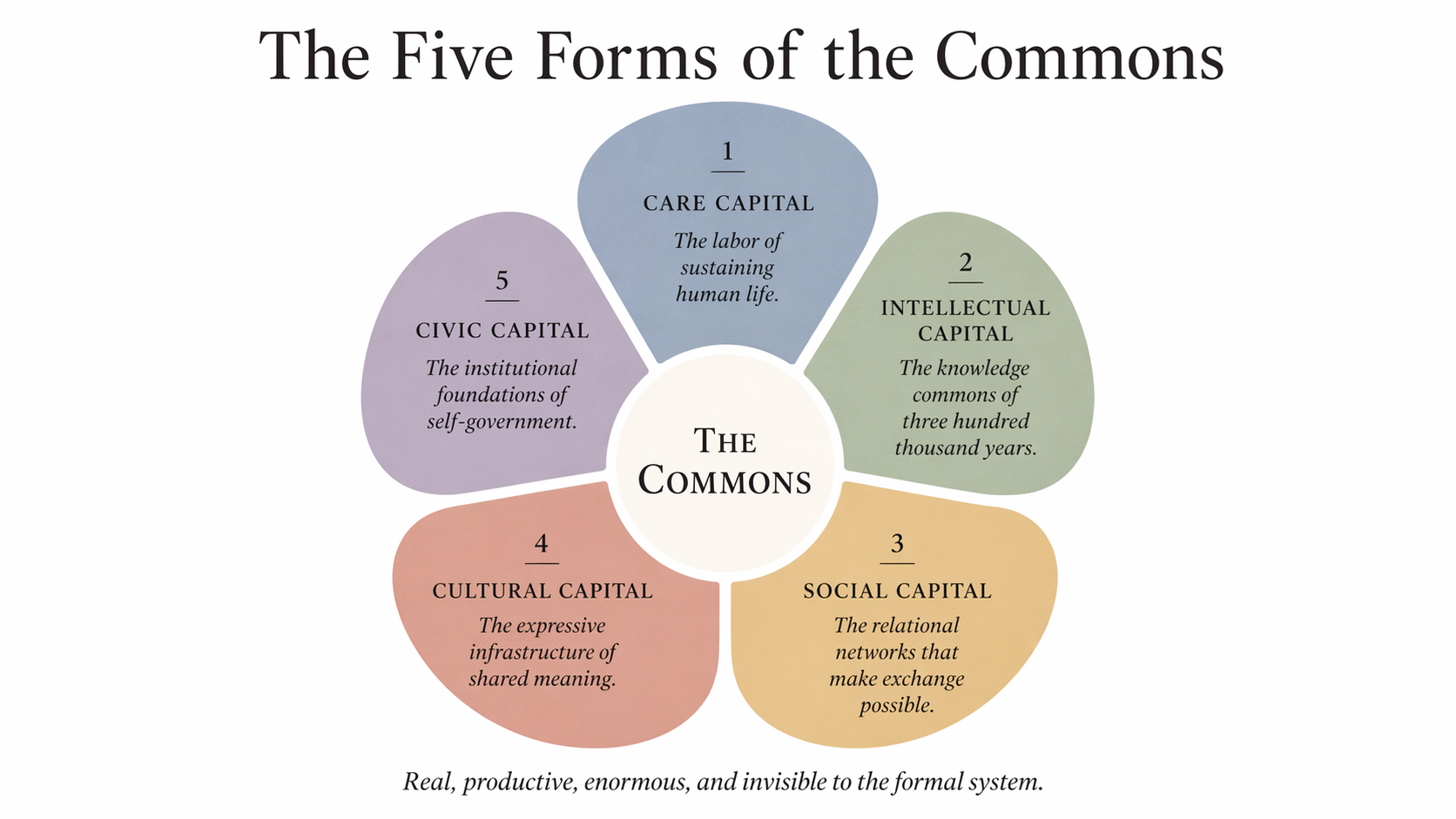
The first is care capital — the labor of sustaining human life: feeding, healing, raising children, supporting the aged and the ill. It is the most essential labor in any economy and the least compensated. It is invisible to formal accounting because it resists enclosure: you cannot standardize care the way you can standardize a manufactured unit, you cannot make it excludable without destroying what makes it valuable, and its returns compound in ways that appear in public health outcomes and workforce productivity decades later rather than on any quarterly balance sheet. Every enterprise depends on a workforce that was raised, educated, fed, and cared for by labor that appeared on no one's books. That labor was not free. It was unaccounted.15
The second is intellectual capital — the knowledge commons. Three hundred thousand years of accumulated human thought: every scientific discovery built on prior discovery, every argument worked out in language developed over millennia, every technical innovation standing on a foundation of publicly funded research and openly shared knowledge. Individual contributions to it are real and traceable. Compensation for those contributions is essentially zero. The mathematical foundations underlying modern AI were developed in publicly funded universities. The linguistic structures that make large language models possible were produced by the entire human species across all of recorded history. None of the contributors hold a stake in the infrastructure their contribution made possible.16
The third is social capital — the relational commons. Robert Putnam spent decades documenting what economists had systematically failed to measure: that the density of networks, norms of reciprocity, and relationships of trust within and across communities is a productive asset that generates real economic returns. He distinguished bonding capital, the dense ties within communities that provide security and enable collective action, from bridging capital, the connections across communities that enable economic mobility and make transactions between strangers possible. Both forms are productive. Neither appears on any balance sheet. Both are being systematically extracted.17
The fourth is cultural capital — the expressive commons. Language itself. Story, music, artistic form, the shared symbols and meaning-making frameworks through which a community understands itself and transmits knowledge across generations. This is not the same as intellectual capital, though they overlap. Cultural capital is the medium in which intellectual capital circulates, the shared expressive infrastructure without which knowledge cannot be accumulated, transmitted, or built upon. It is produced collectively, across generations, through the uncompensated creative work of every person who has ever contributed to a living culture. It is currently being absorbed into AI training sets at a rate that makes individual attribution impossible. Collective compensation, under existing legal frameworks, is unimaginable.18
The fifth is civic and institutional capital — the governance commons. The accumulated work of building and maintaining the public institutions, legal frameworks, democratic norms, and governance structures that make a functioning economy possible. Rule of law. Contract enforcement. Public health infrastructure. Educational systems. The regulatory architecture that makes financial markets trustworthy enough to function. None of these emerge from markets. They are produced by collective human effort across generations, maintained by ongoing civic labor that is largely uncompensated, and treated as free inputs by every private enterprise that depends on them. When they degrade, when civic capital is depleted by the same extraction logic that depletes every other commons, the formal economy loses the substrate it requires without registering the loss until the failure is catastrophic.19
The formal economy is extraordinarily skilled at measuring what capital can price, and capital prices what can be made excludable, transferable, and tradeable. What resists enclosure gets systematically undervalued. The work that most resists enclosure: care, teaching, organizing, the relational labor that makes trust possible and therefore makes commerce possible is the least compensated, least protected, and least visible work in the system. The work most compatible with enclosure: financial engineering, platform architecture, the management of already-concentrated capital is the most compensated, most visible, and most protected. The economy does not get the hierarchy of value wrong by accident. It gets it wrong by design: a design optimized for enclosure, structurally blind to everything enclosure cannot reach.
Hernando De Soto spent decades documenting one dimension of this problem. Traveling through the developing world, he found something that overturned the conventional narrative about poverty: the poor are not poor because they lack assets. They possess enormous assets including informal housing, small businesses, community networks, accumulated knowledge and skill built over lifetimes. What they lack is the legal and institutional infrastructure that converts those assets into capital. Clear title. Enforceable contracts. Formal records. Access to credit markets. Without that infrastructure, the assets are what De Soto called dead capital, real value that cannot be activated, cannot be leveraged, cannot compound. Present but inert.20
The same insight extends to every dimension of the commons. The care worker's twenty years of patient knowledge, the teacher's curriculum, the organizer's network, the scientist's publicly funded research, all of it dead capital, in De Soto's sense: real, enormous, productive, and invisible to the formal system because no institutional architecture has been built to make it legible to the people who produced it.
What cannot be protected will be enclosed.
GDP is not a measure of what was created. It is a measure of what was credited. The gap between those two things, between the full account of what produced value and the narrow account of what received recognition, is this Declaration's operating definition of the problem it is solving. And that gap has never been wider or more consequential than it is right now, as the largest act of commons extraction in human history runs at software speed through every sector of the economy simultaneously.
The Extraction Architecture
The platform economy of the twenty-first century discovered that all five asset classes can be monetized simultaneously through a single architecture. The platform provides a technical interface. Users bring their care relationships, their intellectual output, their social networks, their cultural production, and their civic participation to that interface. The platform captures the data generated by all five, converts it into behavioral prediction products and targeted advertising inventory, and returns nothing to the contributors. The platform does not produce any of the underlying value. It produces the enclosure mechanism, the institutional infrastructure that makes the previously invisible commons legible to capital. It is De Soto's insight inverted: instead of making the commons legible to the people who produced it, it makes the commons legible to whoever owns the platform.
Jaron Lanier identified the structural logic a decade ago. Writing about what he called siren servers, he described platforms whose entire value derived from the collective intelligence and social behavior of their users and which returned nothing to the people whose contributions created that value.21 What he described for social media has now been generalized to every dimension of collective human production simultaneously. Social media extracted the attention, behavioral data, and social capital of billions of living people. Large language models have extracted the intellectual and cultural output of the entire species across all of recorded history. The scale is not comparable in degree. It is different in kind.
Shoshana Zuboff named the governing logic: surveillance capitalism, an economic form in which human experience itself is claimed as raw material for the production of behavioral prediction products sold without the knowledge or consent of the people whose lives generated them.22 Her framework makes visible what GDP cannot measure: the extraction is not incidental to the business model. It is the business model. The platform does not sell a product to its users. It sells its users, their attention, their relationships, their behavioral patterns, their cultural output, their civic participation, to whoever will pay for the predictive power that data generates.
It sells its users — their attention, their relationships,
their behavioral patterns, their cultural output, their civic participation —
to whoever will pay for the predictive power that data generates.
This is why the standard antitrust response to platform monopoly is structurally insufficient. Breaking up a platform addresses market concentration within a single asset class. The platform monopoly operates across all five commons simultaneously. Its power derives not from controlling a specific market but from controlling the infrastructure through which the commons is converted into capital. The problem is not the size of the platforms. It is the architecture of enclosure they represent, and that architecture will reassert itself in any successor platform built on the same ownership logic.
The Final Enclosure
Artificial intelligence concentrates this extraction at a scale that requires a different category of response. The difference is not in the value of the tools. The difference is in what has been absorbed to make them work.
The large language models now foundational to the global economy were trained on the accumulated written output of human civilization: every book that survived long enough to be digitized, every article, every argument, every lesson, every story across every culture and every century. The contributors to that commons number in the billions across all of recorded history. Their collective intellectual and cultural labor created the substrate on which these systems run. They were not asked. They were not compensated. They own nothing of what their contribution made possible. The entire human knowledge commons of every teacher, every scientist, every writer, every storyteller who ever lived has been absorbed into private infrastructure generating returns for a small number of people who arrived at the table with capital at the precise moment the technical capability to perform the absorption became available.
The economic implications are already visible and will accelerate. The Magnificent Seven technology companies — Apple, Microsoft, NVIDIA, Amazon, Alphabet, Meta, Tesla — have driven the majority of equity market returns over the past decade. Their combined market power reflects something the standard concentration metrics do not capture: they are not merely large companies in large markets. They are the owners of the enclosure infrastructure through which the five commons are being converted into private capital. The gains are accruing to asset holders at a rate that makes the post-war productivity-wage divergence look gradual. AI systems increasingly substitute for both cognitive and physical tasks. Wealth accrues to those who own the platforms and the infrastructure. The workers and communities whose knowledge, care, relationships, culture, and civic labor made those systems possible receive nothing from the assets their contribution helped create.
This is not a technology story. It is an ownership story. The tools will be built regardless of how the ownership question is answered. Whoever owns the infrastructure of the enclosure owns the returns from everything the commons produces, and the question of who owns that infrastructure is being decided right now, by a small number of people, with consequences that will compound across generations.
Separation of Powers
The American political tradition has confronted a version of this problem before. In 1787, the framers faced a structural question not unlike the one this Declaration is raising: how do you build an architecture that can hold power without being captured by it? Their answer was not to trust the virtue of any particular person, party, or institution. It was to distribute power across competing branches and levels, to design checks and balances that made concentration irrational rather than merely inadvisable, and to write those distributions into a founding document that no single actor, however popular, however urgent their cause, however compelling their case, could unilaterally overturn.
The architecture worked. Not perfectly, not continuously, not without failures that required centuries of correction. But it worked in the one respect that mattered most: no individual, no faction, no branch of government has been able to accumulate enough power to end the experiment. Presidents overreached. Congresses abused authority. Courts imposed ideology. Parties captured machinery. In every case, the structure provided a mechanism for correction because no single node in the system could disable the others. Two hundred and fifty years is a long time for a political system to hold together in the face of civil war, economic collapse, demagoguery, and technological transformation. It has held because it was designed for distributed power.
No equivalent architecture exists for economic power. The Hamilton-Jefferson debate was about how to govern concentrated ownership, not about whether ownership itself should be distributed. The post-war settlement used redistribution to manage the outputs of concentration without addressing the structure of concentration itself. The platform economy has accelerated concentration at a speed and scale that no redistributive instrument can match. The AI and robotics transition, already underway, is compressing the timeline further.
What the framers did for political power is what the twenty-first century requires for economic power: a structural distribution of ownership and governance across the infrastructure being built right now, written into founding instruments that no subsequent actor can unilaterally overturn. Not because the people building the technology are untrustworthy, but because concentration, once it sets, becomes the architecture that we all build upon. The only discipline durable enough to resist capture is the discipline that refuses to rely on the virtue of whoever happens to hold power at any given moment.
The tools are a given. The architecture is a choice. The people most affected by that choice are not in the room where it is being made.
Every generation that has inherited this republic
has faced some version of the same question:
the institutions built by the previous generation were adequate for the world they lived in
and are no longer adequate for the world that has arrived.
The United States has been here before. Every generation that has inherited this republic has faced some version of the same question: the institutions built by the previous generation were adequate for the world they lived in and are no longer adequate for the world that has arrived. The generation that wrote the Constitution replaced the Articles of Confederation because the Articles could not hold thirteen states together against the centrifugal forces of the new economy. The generation of Lincoln dismantled the slave economy that the founders had deferred resolving, and rebuilt the republic on a foundation the founders had been unwilling to lay. The generation of Theodore Roosevelt and Woodrow Wilson built the regulatory state to govern an industrial economy the framers could not have imagined. The generation of Franklin Roosevelt built the social insurance architecture that made mass prosperity possible for seventy years and that is now, by its own design, reaching the limits of what it can carry. None of those generations inherited an economy they could leave untouched. Each had to take what had been passed to them, assess what still worked, and rebuild what did not.
That is the inheritance, and that is the obligation. The institutions we were given were built by people who understood that the work of passing a functioning republic to the next generation is not preservation. It is reinvention. The question Section IV takes up is which institutions of the twentieth century can carry us forward, which cannot, and what the next architecture has to look like if the productive capacity of the twenty-first-century economy is to be held broadly enough to sustain the democratic commitments the previous architectures were built to protect.